
Key Takeaways
- Keyword volume is one signal, not the full story. It tells you that demand exists, but not where it lives, how it’s being answered, or whether your brand is part of the conversation.
- The Ubersuggest keyword tool and Answer the Public now pull data from Google, Bing, YouTube, TikTok, Instagram, and Amazon, giving you a multi-platform view of where your audience is actually searching.
- AI tools like ChatGPT and Gemini generate answers, not link lists. Ubersuggest’s AI Search Visibility feature tracks whether your brand appears in those answers and how your visibility compares to competitors.
- Ubersuggest’s global keyword data lets you identify regions where demand already exists for your product or service, so you can prioritize expansion instead of guessing.
- The highest-value content opportunities sit at the intersection of strong multi-platform demand and low brand visibility. Knowing where that gap is tells you exactly where to focus.
Search is no longer a single-channel game. For a long time, SEO meant one thing: get found on Google. But Google’s own SVP Prabhakar Raghavan noted that roughly 40 percent of young people now turn to TikTok and Instagram for searches instead of Google, a number that’s only likely to grow over time.
Add ChatGPT, Gemini, YouTube, and other rising channels on top of that, and the picture becomes clear: keyword volume alone can’t tell you where demand actually lives, how it’s being answered, or whether your brand is part of the conversation.
The good news is that Ubersuggest is a great tool to help you adapt to this shift. I’ll cover here how Ubersuggest keyword ideas data actually surfaces, and how to layer multiple signals into a strategy built for the way search works today.
What Keyword Data Actually Tells You (And What It Doesn’t)
Keyword research is still the foundation of any solid content strategy. Search volume tells you how much interest exists around a topic. Keyword difficulty helps you gauge how competitive that space is. Search intent tells you what kind of content actually fits the query. All of that is genuinely useful, and none of it is going away.
But traditional keyword data was built for a world where Google was the only game in town. That world doesn’t exist anymore.
A user today might search “best email marketing tool” on Google, watch comparison videos on YouTube, follow threads on Reddit, scroll TikTok for creator recommendations, and then ask ChatGPT for a final opinion before choosing a product. Each of those touchpoints is a moment of demand. Most keyword research tools only capture one of them.
The practical result: you can have a well-optimized piece ranking on page one for a target keyword and still be invisible to a significant chunk of your audience. That’s not a traffic problem you can fix by adjusting your meta tags.
Two questions worth asking before you build any content plan:
- Where does demand for this topic actually live across platforms?
- Is my brand showing up when people ask AI tools about this subject?
Ubersuggest addresses both. Here’s how each capability works.
How the Ubersuggest Keyword Tool and Answer the Public Surface Multi-Platform Demand
If you used Answer the Public a few years ago, it was a visualization tool that pulled suggestions from Google Autocomplete. Useful, but limited to one platform.
That’s no longer what it is. Answer the Public (now integrated with the Ubersuggest keyword generator) pulls keyword and hashtag data from Google, Bing, Amazon, YouTube, TikTok, and Instagram. That’s a meaningful shift. You’re not just seeing what people type into a search bar anymore. You’re seeing what they watch, hashtag, and shop for across the platforms where they actually spend their time.
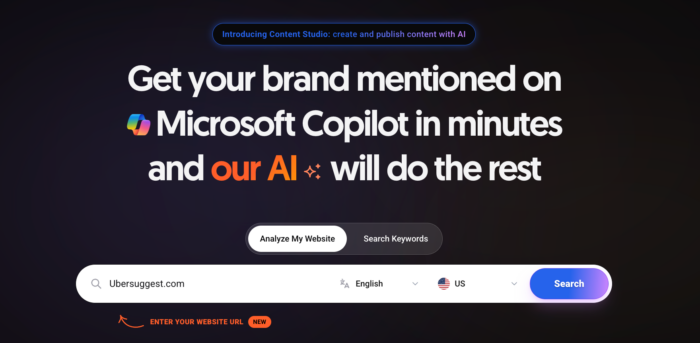
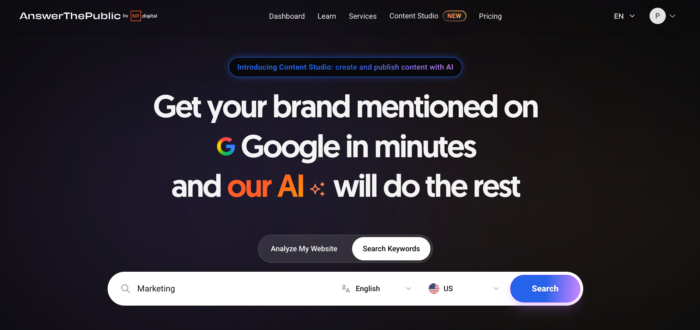
Here’s what that looks like in practice. Enter a broad keyword like “marketing” and select a platform.
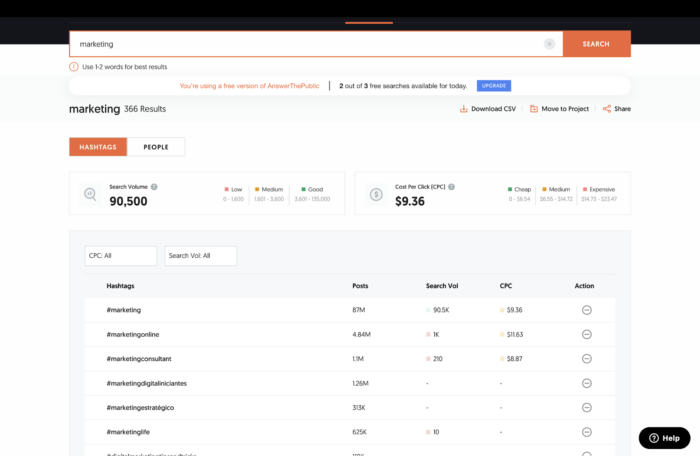
Switch to Instagram and you’ll see the hashtags your audience is actively using around that topic. Switch to TikTok and you get a keyword wheel showing what creators and users are searching within the app.
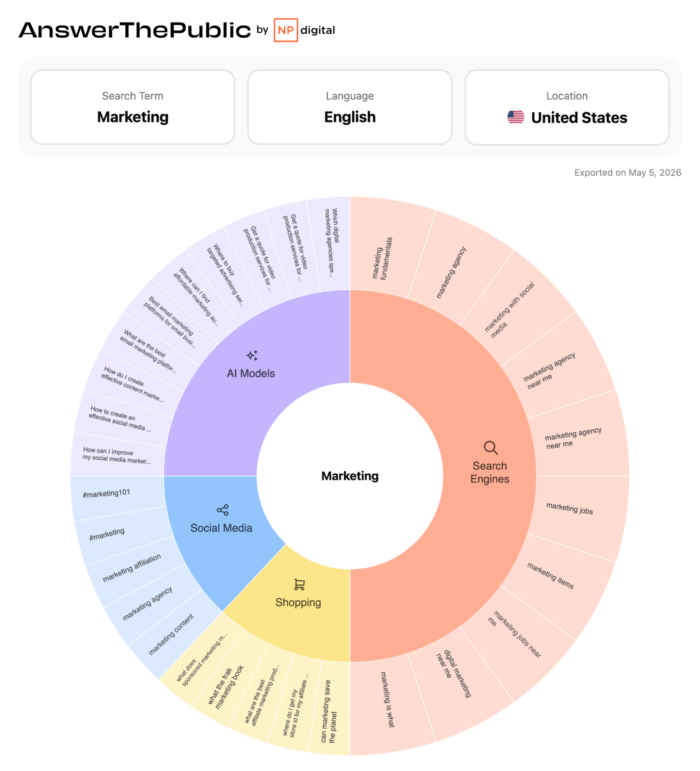
You can also compare how results shift over time, which tells you whether interest in a topic is growing or fading on a specific platform. That matters for content planning. A keyword might have modest Google search volume but strong TikTok traction, which is a signal that short-form video would outperform a blog post for that topic. You’d never see that from Google data alone.
For content teams, this changes the planning conversation. Rather than asking “what should we write?” you start asking “what format and platform does this topic actually call for?” That’s a more useful question, and it leads to content that actually reaches people where they’re searching. For a closer look at using the two tools together, see how to use Answer the Public with Ubersuggest.
The AI Search Layer: What Ubersuggest’s AI Visibility Data Shows You
Multi-platform keyword data covers where demand lives across traditional and social search. AI Search Visibility covers something different: whether your brand shows up when AI tools answer questions in your category.
The distinction matters more than it might seem. When someone asks ChatGPT “what’s the best CRM for a small sales team?” they don’t get ten blue links to evaluate. They get a generated answer. Your brand is either mentioned in that answer or it isn’t. There’s no page-two for AI responses.
This is the core challenge of AI search: it’s not about ranking, it’s about being cited. And right now, most brands have no systematic way to know whether they’re being cited at all.
Ubersuggest’s AI Search Visibility feature is built to solve that. It runs repeated queries across AI platforms, aggregates the results, and gives you a clear, data-backed picture of how often your brand appears in AI-generated responses for your most important topics. One AI response is a data point. Hundreds of responses is a pattern.
The feature surfaces four key metrics:
- Brand Visibility %: How often your brand is mentioned across aggregated AI responses for relevant prompts.
- Industry Rank: Where you sit relative to competitors in your space.
- Top Prompts table: The specific questions and prompts where your brand does and doesn’t appear in AI answers.
- Competitor Visibility trend chart: How competitors’ AI presence is changing over time.
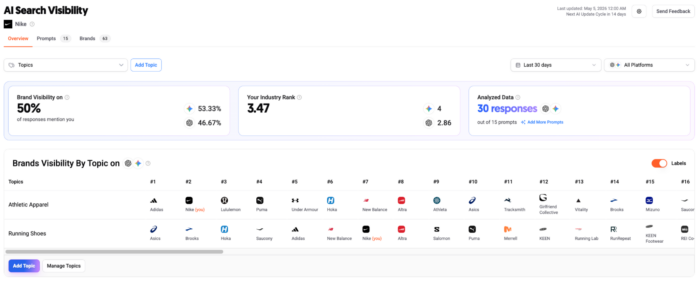
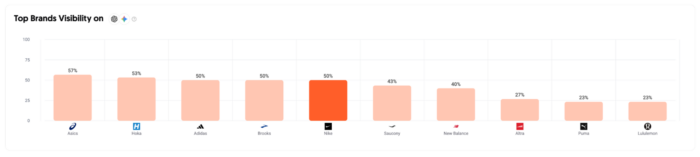
A note on variability: AI responses are inherently inconsistent. Ask the same question twice and you may get a different answer, different brand mentions, or a different level of detail. That’s normal, and it’s exactly why aggregating data across hundreds of repeated queries gives a more reliable read than spot-checking a single response on a given day.
One of the most actionable outputs from this feature is the Top Prompts table. It tells you which specific AI search prompts are driving brand visibility in your category, and which prompts your competitors are dominating without you. Those gaps are your content brief.
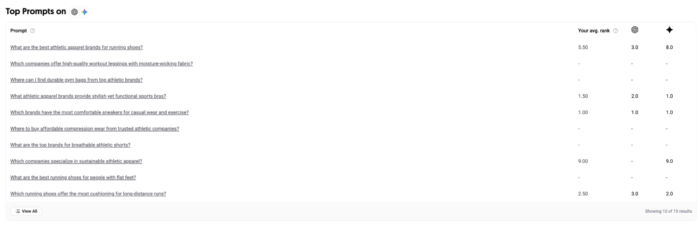
Ubersuggest’s AI visibility features are built to cut through that noise, aggregating responses at scale so your visibility score reflects a real pattern rather than a single snapshot. This is the piece of Ubersuggest keyword research that most marketers haven’t built into their workflow yet. The window to get ahead of competitors here is still open, but it won’t be for long.
Going Global: Using Ubersuggest Data Across Markets
Expanding into new markets is one of the highest-leverage growth moves a brand can make, and one of the most expensive to get wrong. NP Digital now operates in 19 countries, and that growth wasn’t built on guesswork. It came from identifying where demand already existed and going after the regions with the clearest signal first.
Ubersuggest’s global keyword data makes that analysis accessible without a research team. Type any keyword into the Ubersuggest keyword tool, run a search, and filter by country. You’ll see where search volume for your topic is concentrated across global markets.
The insight here is about prioritization. You don’t need to tackle every market at once. You need to find the markets where demand already exists for what you offer, because those are the ones where content and campaigns can work with the grain of existing intent rather than trying to create it from scratch.
Layer in the city-level targeting from AI Search Visibility and you get a second useful data point: not just where people are searching, but where your brand is (or isn’t) showing up in localized AI responses. A market might have strong keyword volume and competitors with high AI visibility, or it might have strong volume and very little AI presence from anyone, which is a wide-open opportunity. That combination turns global expansion strategy from a gut call into a data-backed decision.
For most brands, the low-hanging fruit is closer than it looks. Start by running your core keywords through the global filter and see which regions surface demand you’re currently not serving.
How to Put It All Together
The data points covered above aren’t meant to live in separate tabs. Here’s how to run them as a single workflow.
Step one: map where demand lives.
Use the Ubersuggest keyword tool and Answer the Public to build a multi-platform picture of your topic. Pull keyword volume from Google and Bing, but don’t stop there. Check TikTok and Instagram data for hashtag and creator trends. Check YouTube for video search volume. Check Amazon if your category has a commerce angle. You’re mapping where your audience is actively searching, not just where you’ve historically published.
Step two: audit your AI search presence.
For the topics where you’ve found strong demand, run them through AI Search Visibility. Which prompts is your brand appearing for? Which ones are competitors owning? The Top Prompts table will show you both. If your competitors are consistently cited for a topic your brand should own, that’s a content and PR gap. If nobody in your space is showing up consistently, that’s a first-mover opportunity.
Step three: close the gaps.
The highest-value content opportunities sit where demand is real and brand visibility is low. Those are the topics to build content around, earn citations for, and develop PR relationships that put your brand in front of journalists and creators who influence what AI models learn over time. Publishing more isn’t the goal. Publishing the right content, on the right platforms, on the topics where you’re currently invisible, is.
This framework is repeatable. Run it quarterly as your AI search visibility data evolves and as platform demand shifts. The brands that build this into their routine workflow will compound their advantage over time. For a broader foundation on getting the most out of the platform, the Ubersuggest guide is the right place to start.
FAQs
How accurate is Ubersuggest?
Ubersuggest pulls from multiple sources, including Google’s keyword planner data, to provide search volume estimates. Like any keyword tool, these are estimates rather than exact figures. For most strategy decisions, they’re directionally reliable. For AI Search Visibility, reliability is stronger because the tool aggregates data across hundreds of repeated AI queries rather than relying on a single response, which smooths out the inherent variability of AI-generated answers.
How does Ubersuggest work?
Ubersuggest combines keyword research, site audit tools, competitive analysis, and AI visibility tracking in one platform. For traditional keyword data, it pulls from search engine databases to surface volume, difficulty scores, and related terms. For AI visibility, it runs repeated queries across tools like ChatGPT and Gemini, aggregates the results, and shows how often your brand appears in those AI-generated responses compared to competitors.
How do I use Ubersuggest for keyword research?
Head to app.neilpatel.com, enter a keyword, and review the volume, keyword difficulty score, and related term suggestions. From there, you can filter by country for global demand data, use the Content Ideas tab to see which topics are already performing well in your space, or switch over to Answer the Public to pull platform-specific data from TikTok, Instagram, YouTube, and Amazon alongside traditional search engines.
{
“@context”: ”
“@type”: “FAQPage”,
“mainEntity”: [
{
“@type”: “Question”,
“name”: “How accurate is Ubersuggest?”,
“acceptedAnswer”: {
“@type”: “Answer”,
“text”: “
Ubersuggest pulls from multiple sources, including Google’s keyword planner data, to provide search volume estimates. Like any keyword tool, these are estimates rather than exact figures. For most strategy decisions, they’re directionally reliable. For AI Search Visibility, reliability is stronger because the tool aggregates data across hundreds of repeated AI queries rather than relying on a single response, which smooths out the inherent variability of AI-generated answers.
”
}
}
, {
“@type”: “Question”,
“name”: “How does Ubersuggest work?”,
“acceptedAnswer”: {
“@type”: “Answer”,
“text”: “
Ubersuggest combines keyword research, site audit tools, competitive analysis, and AI visibility tracking in one platform. For traditional keyword data, it pulls from search engine databases to surface volume, difficulty scores, and related terms. For AI visibility, it runs repeated queries across tools like ChatGPT and Gemini, aggregates the results, and shows how often your brand appears in those AI-generated responses compared to competitors.
”
}
}
, {
“@type”: “Question”,
“name”: “How do I use Ubersuggest for keyword research?”,
“acceptedAnswer”: {
“@type”: “Answer”,
“text”: “
Head to app.neilpatel.com, enter a keyword, and review the volume, keyword difficulty score, and related term suggestions. From there, you can filter by country for global demand data, use the Content Ideas tab to see which topics are already performing well in your space, or switch over to Answer the Public to pull platform-specific data from TikTok, Instagram, YouTube, and Amazon alongside traditional search engines.
”
}
}
]
}
Conclusion
To do marketing well in today’s world, you need to optimize for multiple platforms and regions.
SEO is no longer just a “Google” game. You must optimize for YouTube, Instagram, TikTok, ChatGPT, and all the other platforms your users use.
On top of that, you should look to expand globally.
Now, it’s too hard to tackle every country, but go after the low-hanging fruit first. What other countries have demand for your products and services? Those are the countries worth considering to move into next.