
Key Takeaways
- AI lead generation works best as a system, not a collection of separate tools. The three core layers are data, activation, and optimization.
- Traditional lead gen breaks at scale because teams fragment strategy across locations, operate in silos, and rely on manual budget decisions.
- Local search carries the highest purchase intent in digital marketing. Most multi-location brands are losing those searches due to inconsistent listings and weak profiles.
- AI improves lead quality, not just volume. Lead-to-close rate by location is the metric that actually matters.
- You don’t need a full overhaul to start. A focused 30-day rollout can produce measurable pipeline impact.
Multi-location brands are generating more leads than ever. And yet, many are still struggling to turn that activity into consistent revenue across every market they serve.
Here’s the real problem: traditional lead gen was never built for scale. It was built for one team, one market, one campaign at a time. The moment you’re managing dozens or hundreds of locations, that model cracks. Fragmentation sets in. Quality drops. And the manual work required to hold it all together eats your team alive.
AI lead generation changes the equation entirely, but only if you use it the right way. This isn’t about automating what you’re already doing. It’s about building a system that gets smarter across every location, every market, every campaign, at the same time.
This article lays out how to actually do that.
Why Traditional Lead Gen Breaks at Scale
Multi-location lead gen has three structural failure points. Once you can see them clearly, the solution becomes obvious.
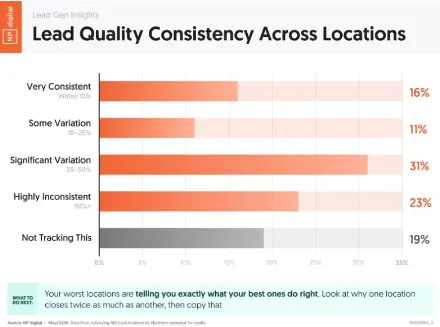
Fragmentation. Different teams run different playbooks in different markets. There’s no shared learning system, no central source of truth, and no way to know why your top location outperforms your worst one. According to NP Digital survey data, only 16 percent of multi-location businesses report “very consistent” lead quality across their locations. The majority fall somewhere between “significant variation” and “highly inconsistent.”
Inconsistent quality. High lead volume in one region doesn’t translate to high revenue. The locations that look like top performers by lead count often rank near the bottom by close rate. Without visibility into lead quality at the location level, you’re optimizing for the wrong thing.
Manual optimization that can’t keep pace. Most teams still allocate budget manually, review performance monthly, and build campaigns market by market. That cadence worked when the scale was manageable. At 50 or 100 locations, it’s a liability. Budget decisions made quarterly can’t respond to demand signals that shift weekly.
Buyers make it harder, too. By the time someone contacts your business, they’ve already researched you using search, reviews, and word of mouth. 98 percent of consumers verify an AI-recommended brand before buying, and about 65 percent of Google searches now end without a click to any website. Your presence has to be consistent, accurate, and compelling long before a lead form ever gets filled out.
The old model is broken. The fix isn’t more campaigns. It’s a better system.
The AI-Powered Lead Gen Framework
The brands scaling successfully with AI for lead generation aren’t just using more tools. They’re using tools that connect.
Most companies have pieces of the puzzle. The problem is those pieces don’t talk to each other. Paid media AI can’t access your lead scoring data, so you optimize for clicks that don’t convert. Local listing data lives in a separate system, so top-performing locations can’t surface insights to underperformers. Performance data stays siloed in individual markets and never informs the broader strategy.

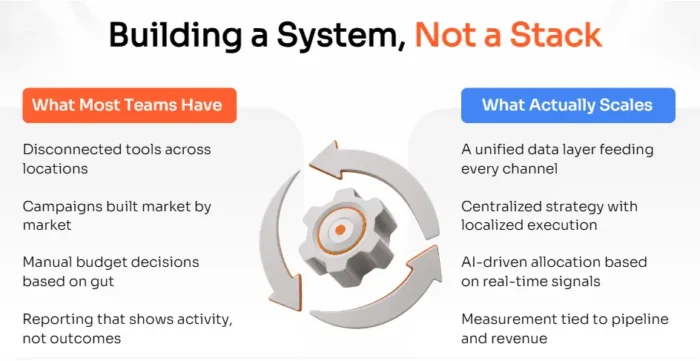
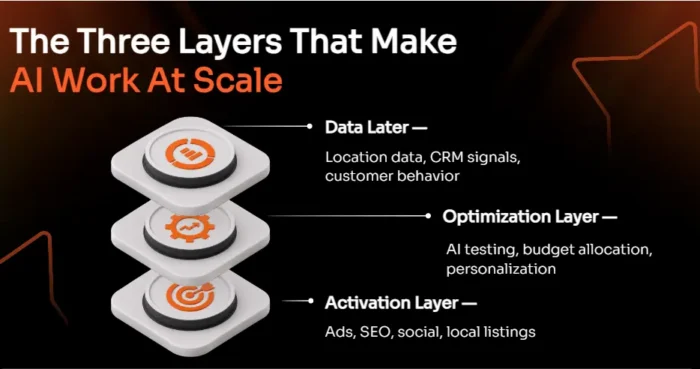
The AI-powered lead gen framework has three layers:
Data Layer: Location data, CRM signals, and customer behavior. This is the foundation. If your data is fragmented or inconsistent, everything built on top of it will be, too.
Activation Layer: Ads, SEO, social, and local listings. These are your channels. The goal is to run them from a centralized playbook while adapting execution to each market’s demand signals.
Optimization Layer: AI testing, budget allocation, and personalization. This is where the system learns. It improves not just individual campaigns, but the entire operation simultaneously.

The key distinction is centralized strategy with localized execution. Brand messaging, campaign frameworks, and budget guardrails are set at the top. Creative, offers, and targeting adapt to each market’s specific signals. AI models are trained on the full dataset, not just one region, so outputs are informed by what’s actually working across your entire footprint.
This is how you stop duplicating the same campaign across 50 markets and start building something that compounds. Scale doesn’t come from more campaigns. It comes from smarter systems,
AI and Local Search: Capturing High-Intent Demand at Scale
Your next customer isn’t searching for your brand name. They’re searching “near me.” And that intent matters enormously.
“Near me” searches carry some of the highest purchase intent in all of digital marketing. The problem is that most multi-location brands lose those searches before they ever have a chance to convert. The culprits are predictable: inconsistent Google Business Profiles, weak local SEO signals, and no coherent review strategy.
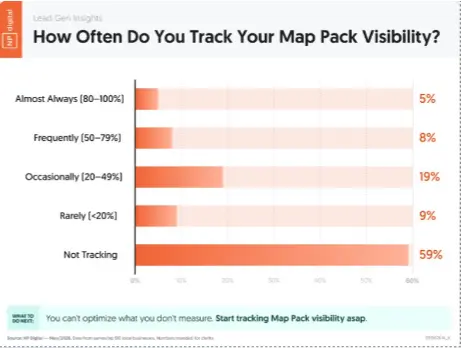
NP Digital’s research found that 59 percent of multi-location businesses are not tracking their Map Pack visibility at all. You can’t optimize what you don’t measure, and you can’t win local search if you’re not paying attention to it.

AI addresses each of these gaps directly.
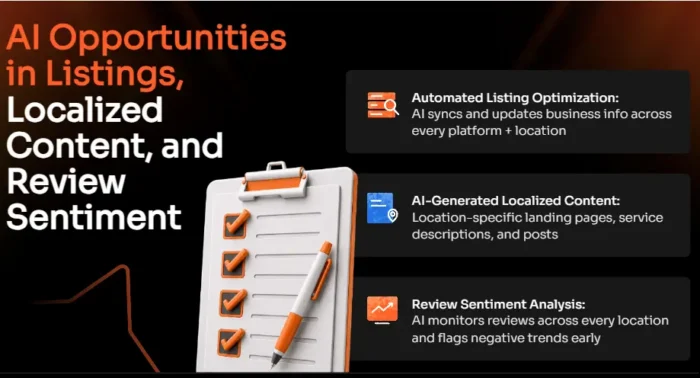
Automated listing optimization keeps your business information accurate and consistent across every platform and every location simultaneously. Name, address, and phone number (NAP) inconsistency is one of the most common reasons brands lose local rankings. AI can audit and sync that data at a scale no manual process can match.
AI-generated localized content means each location gets landing pages, service descriptions, and posts that reflect its specific market, without requiring a dedicated content team for every region. Add schema markup so search engines and AI tools can surface your location data in map features and AI-generated answers.
Review sentiment analysis lets you monitor feedback across every location and flag negative trends early, before they compound into a visibility or reputation problem.

The metrics that matter at the location level: local visibility share, calls and direction requests, and location-level conversion rates. Track these per location, not just in aggregate, and the gaps in your strategy become obvious fast.
Scaling Paid Media Across Locations Without Wasting Budget
Manually managing paid ads across 100+ locations is where growth breaks.
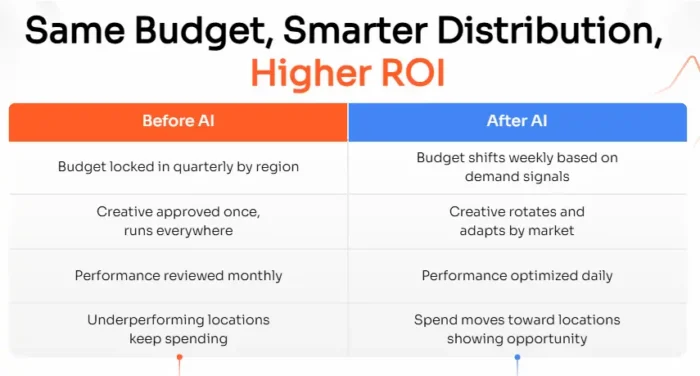
Budget gets spread evenly across markets regardless of demand. Creative runs until someone manually pulls it. Performance gets reviewed monthly, by which point underperforming campaigns have already wasted weeks of spend. No one is learning what actually works in each market, because the data stays local.
AI fixes all three. Here’s how it works in practice:
Performance Max runs across Search, Display, YouTube, Maps, and Discovery from a single campaign structure. Rather than building separate campaigns for each location, you set the inputs and let AI distribute across channels based on where demand is showing up.
Dynamic creative optimization means AI is testing headline, image, and call-to-action combinations by market automatically. Creative adapts to what resonates locally, rather than running a single approved version everywhere.
Demand-based budget reallocation is the biggest unlock. NP Digital’s research shows that only seven percent of multi-location businesses use AI or automation to guide budget allocation. The majority allocate manually or based on historical performance. That means most brands are treating their best markets the same as their worst ones.
AI shifts spend toward the locations showing real-time opportunity signals. Same total budget, redistributed by what’s actually working right now. The result: the same dollar goes further because it’s going where it’s most likely to convert.

For more on building a paid strategy that generates more leads without inflating spend, this post breaks down the fundamentals.
Personalization Across Markets: Why One Message Doesn’t Fit All
Customers in Phoenix don’t behave like customers in New York. Generic messaging across locations produces low engagement and lower conversion rates.
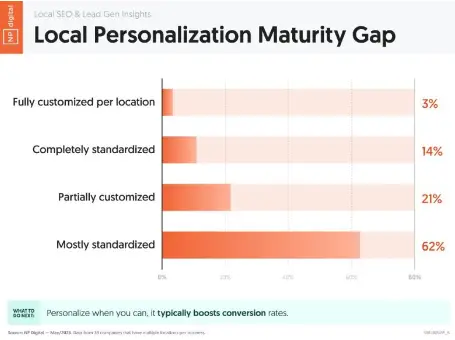
NP Digital’s Personalization Maturity by Location data tells the story: 62 percent of multi-location brands are still “mostly standardized” in how they reach customers across markets. Only three percent are fully customized per location. The gap between standardized and partially customized is where most of the conversion lift is hiding.

AI enables three things that manual personalization can’t deliver at scale:
Location-based messaging adjusts the content, offers, and tone of your campaigns based on where a user is and what that market’s demand signals look like. A promotion that converts in one region might be irrelevant in another. AI can surface those distinctions without a marketer manually monitoring every market.
Behavioral personalization goes further. Rather than one-size-fits-all follow-up sequences, AI can trigger personalized responses based on how a specific lead has interacted with your content. The follow-up feels timely and relevant because it is.
Localized ad creative adapts headlines, images, and calls-to-action by market automatically. What works in a competitive urban market is often different from what converts in a suburban or rural one.
Each location also needs its own landing page with unique copy, local reviews, and the specific services offered there. Region-specific pages aren’t just an SEO play. They’re what closes the gap between click and conversion.
Relevance drives conversion. AI delivers relevance at scale.
Lead Quality Over Lead Volume: What AI Actually Optimizes For
More leads does not mean more revenue, especially across locations where quality varies wildly by region.
The metric most multi-location teams are missing is lead-to-close rate by location. It tells you which markets actually convert customers, not just which ones fill the top of the funnel. Without it, you’re optimizing for activity, not revenue.
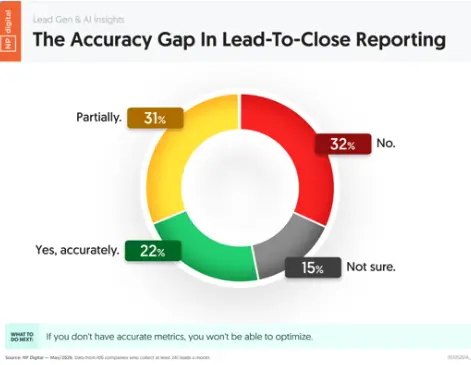
NP Digital’s data shows that only 22 percent of companies can accurately track lead-to-close by location. Another 32 percent say they can’t do it at all. That means two-thirds of multi-location brands are flying blind on the metric that matters most for growth.

Three metrics separate volume from value:
Lead-to-close rate by location. Which markets are actually converting? This is the signal that tells you where to invest more and where to pull back.
Cost per qualified lead. Not cost per lead. Cost per lead that had a real chance of closing. The difference often reveals which channels are generating noise and which are generating pipeline.
Pipeline contribution. Which locations, channels, and campaigns are directly tied to revenue? This is the number that justifies more investment, and the one most teams can’t answer accurately.
AI addresses each of these through lead scoring models that evaluate more variables per lead than any human team can process manually, smart routing that gets the right lead to the right team within minutes based on location, service type, and availability, and predictive conversion optimization that improves over time as the system learns which signals actually predict a close.
For teams looking to build better systems for nurturing leads once they enter the funnel, that post covers the mechanics in detail.
The 30-Day AI Lead Gen Rollout Plan
You don’t need a full transformation to start seeing results. A focused, four-week rollout can produce measurable pipeline impact, and it gives your team a framework to build on.
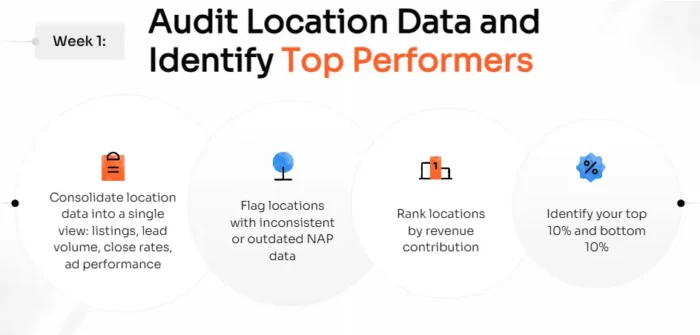
Week 1: Audit location data and identify top performers. Pull all location data into a single view: listings, lead volume, close rates, and ad performance. Flag any locations with inconsistent or outdated NAP data. Rank locations by revenue contribution, and identify your top 10 percent and bottom 10 percent. The gap between them is your opportunity map.
Specifically: go into your Google Business Profile dashboard and note which locations are incomplete, missing photos, or haven’t had a review responded to in more than 30 days. That list becomes your Week 2 priority.

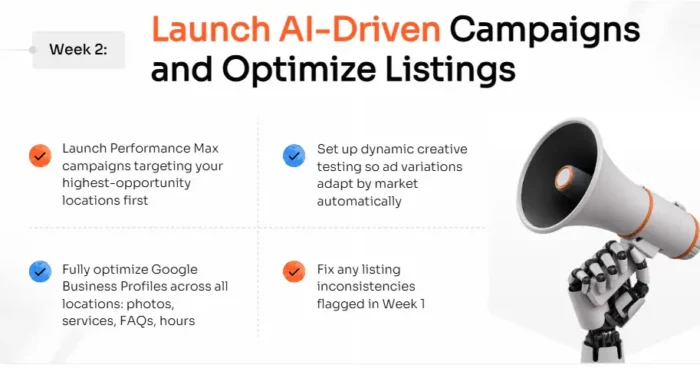
Week 2: Launch AI-driven campaigns and optimize listings. Launch Performance Max campaigns targeting your highest-opportunity locations first. At the same time, fully optimize Google Business Profiles across all locations, including photos, services, FAQs, and hours. Set up dynamic creative testing so ad variations can start adapting by market automatically. Fix the listing inconsistencies flagged in Week 1.

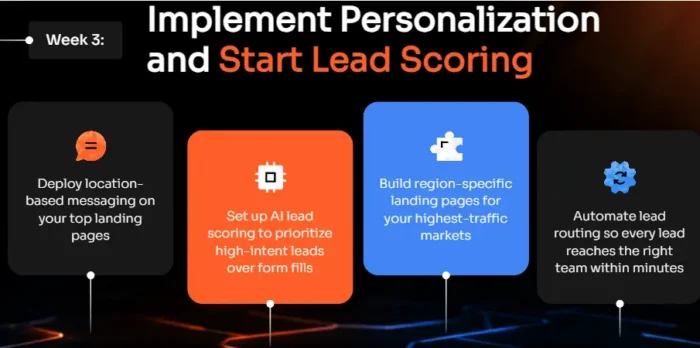
Week 3: Implement personalization and start lead scoring. Deploy location-based messaging on your top landing pages. Set up AI lead scoring to prioritize high-intent leads over raw form fills. Build region-specific landing pages for your highest-traffic markets. Automate lead routing so every inbound lead reaches the right team within minutes, not hours.

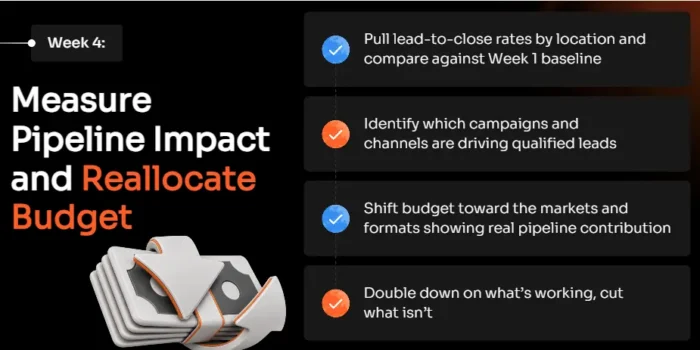
Week 4: Measure pipeline impact and reallocate budget. Pull lead-to-close rates by location and compare against your Week 1 baseline. Identify which campaigns and channels are driving qualified leads. Shift budget toward the markets and formats showing real pipeline contribution. Cut what isn’t working.
Small AI implementations compound quickly. The goal of this rollout isn’t to solve everything at once. It’s to build a feedback loop that makes your system smarter every week.
For teams that want to layer in automation across the nurturing side of the funnel, lead nurture automation is worth reading before you get into Week 3.

FAQs
How to use AI for lead generation?
Start with the data layer: consolidate your location data, CRM signals, and customer behavior into a unified view. From there, activate AI across your paid campaigns, local listings, and content. Use the optimization layer, AI testing, budget reallocation, and personalization, to improve performance across all channels simultaneously rather than one at a time.
How does AI lead generation work?
AI lead generation uses machine learning to identify high-intent prospects, score and route leads based on conversion likelihood, personalize outreach by market, and reallocate budget toward the channels and locations showing the best performance in real time. The key is building a system where these tools share data, rather than operating in separate silos.
How can AI agents boost lead generation and sales?
AI agents can handle the repetitive, data-intensive work that slows human teams down: monitoring listing consistency, running creative tests across hundreds of markets, scoring inbound leads, and routing them to the right sales rep within minutes. That speed and precision at scale is what produces conversion lift.
{
“@context”: ”
“@type”: “FAQPage”,
“mainEntity”: [
{
“@type”: “Question”,
“name”: “How to use AI for lead generation?”,
“acceptedAnswer”: {
“@type”: “Answer”,
“text”: “
Start with the data layer: consolidate your location data, CRM signals, and customer behavior into a unified view. From there, activate AI across your paid campaigns, local listings, and content. Use the optimization layer, AI testing, budget reallocation, and personalization, to improve performance across all channels simultaneously rather than one at a time.
”
}
}
, {
“@type”: “Question”,
“name”: “How does AI lead generation work?”,
“acceptedAnswer”: {
“@type”: “Answer”,
“text”: “
AI lead generation uses machine learning to identify high-intent prospects, score and route leads based on conversion likelihood, personalize outreach by market, and reallocate budget toward the channels and locations showing the best performance in real time. The key is building a system where these tools share data, rather than operating in separate silos.
”
}
}
, {
“@type”: “Question”,
“name”: “How can AI agents boost lead generation and sales?”,
“acceptedAnswer”: {
“@type”: “Answer”,
“text”: “
AI agents can handle the repetitive, data-intensive work that slows human teams down: monitoring listing consistency, running creative tests across hundreds of markets, scoring inbound leads, and routing them to the right sales rep within minutes. That speed and precision at scale is what produces conversion lift.
”
}
}
]
}
Conclusion
The brands that win won’t just generate more leads. They’ll generate better ones, faster, and across every market they serve.
Multi-location complexity is only going to grow. New locations, new markets, more channels, more data. The gap between brands that build AI systems now and those that wait will widen quickly. The difference between a system that scales and one that fragments under pressure isn’t budget; it’s infrastructure.
Start with the audit. Build the connective tissue between your data, activation, and optimization layers. And measure at the location level, because that’s where the real signal lives.
If you want support building out that system, NP Digital’s consulting team works with multi-location brands on exactly this. If you want deeper insights on this topic, check out the full webinar as well.