

The Hidden Wealth in Your Home
You read that right. You can get a Home Equity Line of Credit (HELOC) on your house to invest, and I’ll explain how the monthly payment can be covered while you build wealth.
Most homeowners look at their home equity as a “someday” thing:
“Oh cool, my house went up in value. I guess I’ll enjoy that when I’m 67.”
But here’s what most people don’t realize: that equity could start paying you while you’re still young enough to enjoy it.
In fact, according to a major report, the average American homeowner currently has over $300,000 in equity. That’s a significant asset sitting idle.
In this guide, we’ll cover:
- What home equity actually means
- How a HELOC works in plain English
- The risks and benefits of using your equity
- A powerful strategy to make your HELOC payment for you
- Why lease options can transform your cash flow
What Is Home Equity?
Let’s break this down in normal person language.

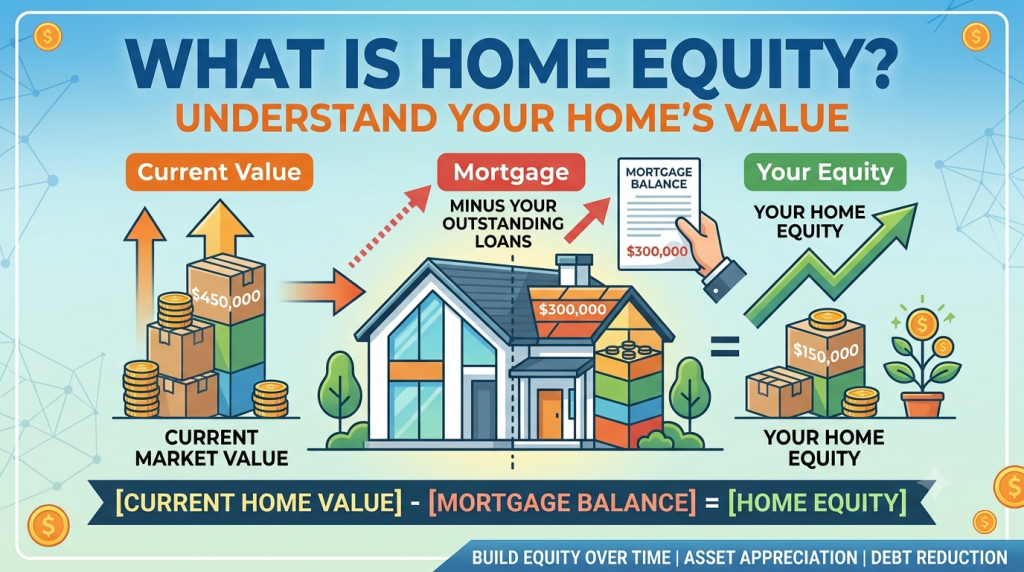
You bought a house. You’ve been making payments for the last 5 or 10 years. Two things happened at the same time:
- The market value moved up
- Your loan balance moved down
The gap between what your house is worth and what you still owe — that’s called equity.
Example:
| Item | Amount |
|---|---|
| Home value | $500,000 |
| What you owe | $300,000 |
| Your equity | $200,000 |
That $200,000 is essentially the part of the house you already own on paper.
The Annoying Part
Most people think the only way to touch that equity is to sell the house. But what if you could access it without:
- Selling your home
- Moving your family
- Uprooting your life
That’s where a HELOC comes in.
What Is a HELOC?
HELOC stands for Home Equity Line of Credit.
Think of it as a credit card linked to the equity in your home. The bank says:
“You’ve got security in this house. We’re going to give you access to a big portion of your equity. Go ahead and use it when you need it.”
Why Banks Like HELOCs
Banks love lending money when it’s tied to an asset. If you don’t pay a credit card, they send angry letters. If you don’t pay a loan tied to a house, they’ve got something real behind it.
This makes them:
- More comfortable lending
- Able to offer much lower interest rates
- Willing to give you access to a lot of money
How Much Can You Get?
Most lenders use something called Combined Loan-to-Value (CLTV) — a fancy way of saying how much total debt you’ll have compared to your home’s value.
The common ceiling is 80% to 90% of your home’s value.
Example:
| Item | Amount |
|---|---|
| Home value | $500,000 |
| Max bank lending (90%) | $450,000 |
| What you currently owe | $300,000 |
| Available HELOC | $150,000 |
The Key Advantage
You only pay interest on what you use, not on the entire limit. If you don’t use it, you don’t pay anything at all.
💡 You can open a HELOC for free, use it when you need it, and pay it back again.
The Risk: What You Need to Know
I’m not going to sugarcoat this part.
The moment you borrow that money, you have a new monthly payment.
- The interest rate is usually much lower than a credit card
- But it’s still a payment you must factor into your plan
The Smart Way to Use a HELOC
I am not advocating getting a HELOC to buy:
- ❌ A boat
- ❌ A car
- ❌ A vacation
- ❌ Anything that is a liability
Instead, this article is about using your HELOC to buy assets that make you more money than the HELOC payment.
How to Make Your HELOC Payment for You
You might be wondering:
“Kris, why would you make my HELOC payment for me?”
The answer is simple: when we partner on real estate, the deals we find generate significantly more money than that HELOC payment.
The Problem with Traditional Rentals
Most rentals are simple:
- Rent the home to someone who wants to rent
- Hope they don’t destroy the place
- Hope the math works
- Deal with repairs, vacancies, and rising costs
One water heater or roof repair can literally cancel out all your cash flow for the entire year.
The Solution: Lease Options
A lease option (also called rent-to-own) flips the entire relationship around.
What Is a Lease Option?
A lease option is a lease combined with an option agreement. It lets the tenant choose to purchase the home at the end of a term (typically 24 months).
The tenant:
- Has the right (not obligation) to buy the home later
- Pays a non-refundable option fee upfront
- Pays a higher monthly rent (rent premium)
- Takes responsibility for repairs and upkeep
- Treats the property like they’re buying it — because they plan to
3 Major Benefits of Lease Options
1. Upfront Option Fee
The tenant pays an option fee for the exclusive right to buy the home down the road. This fee is typically $10,000 to $20,000 on average.
This is money you get to keep upfront.
2. Rent Premium
Because the tenant is working toward ownership, they’re willing to pay significantly more than a normal renter.
Example:
| Income Stream | Amount |
|---|---|
| Normal rent premium | $300/month |
| Additional rent premium | $400/month |
| Total monthly cash flow | $700/month |
When you factor in the option fee amortized over time, that can become $1,000 to $1,500 per month.
3. Reduced Maintenance Costs
In a traditional rental, the landlord pays for:
- Water heater replacements
- Roof repairs
- Appliances
- General upkeep
In a lease option, the tenant becomes responsible for all repairs and upkeep because they’re treating this like a home they plan to buy.
Why This Matters for You
If you invest using a lease option strategy:
- The higher cash flow covers your HELOC payment
- You still have plenty of money left over
- You’re building equity without the landlord headaches
- You’re helping someone become a homeowner — a true win-win
What This Means for Your Financial Freedom
When I was 26 years old, I had 25 properties. They cash flowed me $12,500 a month, which was enough to replace my job.
That’s what most people really want — not just to be rich, but to have their time back. Financial freedom. Residual income.
How to Get Started
Step 1: Find Your Equity
Go find out how much equity you have in your home. You can:
- Check Zillow or similar sites for an estimate
- Use ChatGPT or online calculators
- Contact your lender
If that number is bigger than $50,000, you have a significant asset you can put to work.
Step 2: Do Your Research
Before using your equity, make sure you understand:
- The risks involved
- The monthly payment you’re committing to
- The investment strategy you’ll use
Step 3: Consider Your Options
There are many ways to invest in real estate:
| Strategy | Description |
|---|---|
| House Hacking | Buy a property, live in one part, rent out the rest |
| Wholesaling | Find discounted properties and assign contracts |
| Fix and Flips | Buy, renovate, and sell for profit |
| Lease Options | Rent-to-own with tenants who plan to buy |
| Private Lending | Lend money to other investors |
Step 4: Seek Professional Guidance
Real estate investing can be complex. Consider working with:
- A qualified real estate mentor
- A trusted real estate attorney
- A CPA who understands investment properties
Final Thoughts
Your home equity doesn’t have to sit idle until retirement. It can become a powerful tool to build wealth and create passive income — while you’re still young enough to enjoy it.
Lease options are one of the most effective strategies available today because they:
- Generate higher cash flow than traditional rentals
- Reduce maintenance headaches
- Help tenants become homeowners
- Create a genuine win-win for everyone involved
Key Takeaways
| Point | Summary |
|---|---|
| 1 | Home equity is a valuable asset — use it wisely |
| 2 | A HELOC gives you access to equity without selling |
| 3 | Use HELOC funds for assets, not liabilities |
| 4 | Lease options can generate higher returns than rentals |
| 5 | Work with professionals to minimize risk |
Ready to explore your options? Find out how much equity you have and start planning your next move today!
Disclaimer: This article is for educational purposes only and does not constitute financial, investment, or legal advice. Always consult with qualified professionals before making financial decisions. Past performance does not guarantee future results. Individual results may vary.